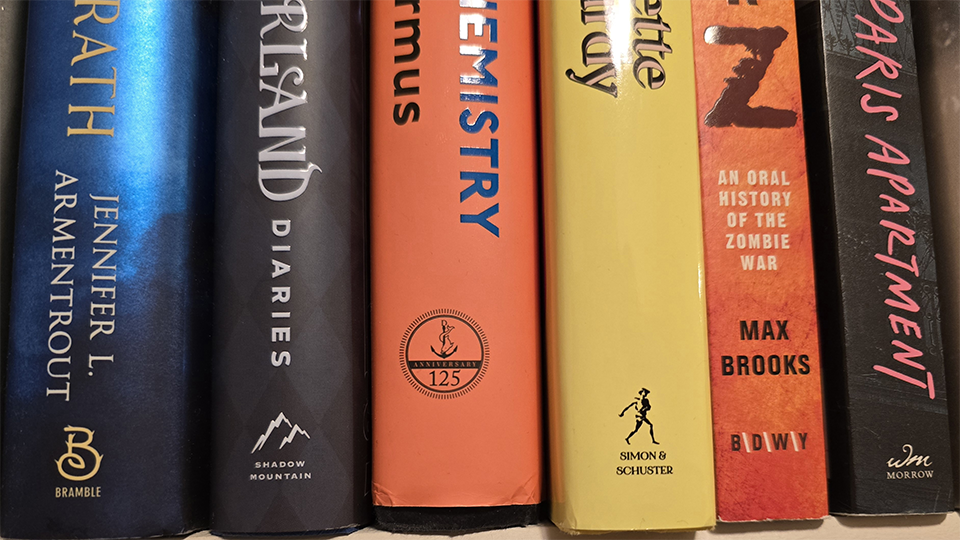
You’ve probably heard of some of the biggest companies in the book publishing game before—think Penguin Random House, HarperCollins, Simon & Schuster, Macmillan, and Hachette. These companies are referred to as the Big Five in book publishing, and they make up a sizable portion of the trade publishing industry. Who, then, are Viking, Harlequin, and St. Martin’s Griffin, and why are their names on the spines of my books?
Those, dear readers, are called imprints, and they’re the structural and organizational backbone of most trade book publishing. Essentially, each imprint is its own publishing company. They often specialize in a particular genre and are creatively independent from their parent publishing houses—their relationship with said parent company (i.e., the Big Five or other company that owns them) is largely financial. As an example, Yellowface by R. F. Kuang was published by William Morrow, which is an imprint of HarperCollins. (Here is a link to a flowchart of some different imprints and how they are organized under each of the Big Five houses.)
Publishers grow into larger companies by acquiring other imprints, smaller presses, or indie houses. The Big Five used to be the Big Six, but in 2013, Penguin and Random House completed a merger into a single entity, becoming Penguin Random House.1 In 2020, PRH reached an agreement to purchase Simon & Schuster, but a federal judge blocked the merger in 2023, citing antitrust laws.2 A publisher can also see a competitive space in the market and create a new imprint. In 2023, Tor Publishing Group (a subsidiary of Macmillan) launched Bramble, a brand-new imprint designed to publish romance titles with a twist, throwing its hat into the competitive landscape of romantasy and other contemporary genre romance.3
In a Big Five context, imprints work like genetic code. Penguin Random House is the largest trade publisher in the United States, comprising more than three hundred unique imprints. Each imprint specializes in a slightly different corner of the market: Dutton publishes thrillers, memoirs, pop culture, and narrative non-fiction; Kokila publishes picture books, middle-grade, and YA; Penguin Classics publishes new versions of the classics, and so forth. Editors at each imprint acquire and develop titles that fit within the scope of their imprint’s guidelines—a book acquired by Kokila would likely not meet the requirements to be published at Dutton, even though they are both imprints of Penguin Random House. This allows PRH to take up more space in the industry and on your shelves.
Not all books come from the Big Five, though. Although these five companies are responsible for roughly 64% of trade publishing revenue in the US, countless smaller presses put out around 80% to 90% of new titles in the US every year.4 Smaller presses and imprints tend to have much more cohesive identities and specialties compared to their mega-conglomerate industry counterparts. As an example, Ooligan Press (shameless plug) is an independent, student-run publisher. We focus on releasing titles related to the Pacific Northwest region of the US, especially seeking to highlight work from underrepresented and underserved demographics. You can tell a book comes from our press by the trademark fishing hook on the spine of our titles (check out Ooligan’s books here).
Most readers don’t have a favorite imprint—most probably couldn’t even name more than a handful. But it’s possible you could have a favorite—or a few favorites—without even realizing it. Take a look at one of your favorite books you own, and focus on the logo at the bottom of the spine. See the imprint logo? Now, look at your entire collection. Are there repeated imprints across your personal library? Try exploring other titles offered by the imprints that publish your favorite books. You might just find a new favorite.
Sources:
- “Random House, Penguin Merger Completed.” Publishers Weekly. 1 July 2023.
- PRH merger finalized in 2013.
- Milliot, Jim. “KKR Completes Purchase of Simon & Schuster.” Publishers Weekly. 30 October 2023.
- PRH blocked from purchasing Simon & Schuster in 2023.
- Stewart, Sophia. “Tor Publishing Group Launches Romance Imprint.” Publishers Weekly. 14 February 2023.
- Bramble imprint to launch in fall of 2023.
- Curcic, Dimitrije. “The Big Five Publishers Statistics.” Wordsrated. 17 November 2022.
- Big Five publishing statistics.