Have you ever wondered what a Tip Sheet is? Or maybe you know but are lost on what they’re used for—much less how to make them. Today I’ll be going into all the details, including resources, design possibilities, audience considerations, and where to send your Tip Sheet when it’s done!
What Is a Tip Sheet?
When you’re applying for a job, what’s the first thing you think about making? That’s right—a resume! In the publishing world, think of a Tip Sheet as a book’s resume. When all is said and done with writing and editing, a book still needs to be distributed to sellers such as Barnes & Noble or your local shops like Powell’s Books here in Portland. Both corporate chains and independent bookstores use Tip Sheets to decide what titles to stock when it comes to new books, but it doesn’t stop there—not when there are libraries! Even though libraries think less about book sales and more about what titles work for the community, Tip Sheets are still wonderful tools to quickly understand the key points of a title and how it would serve both sales and borrowing for readers.
Who Makes a Tip Sheet?
When you’re applying for a job, you’re essentially selling your history and qualifications to a company in hopes they hire you. Tip Sheets, then, are a sales document. Most would think the marketing department is solely responsible, but Tip Sheets are a collaborative document.
Editors are the ones who read (and edit) the book. They also champion the title to everyone they come across and do so because they understand deeper themes. They also flag comp (comparative and competitive) titles—not to mention those little nuances marketing could miss.
The sales department of any company is vital, and that is equally true in the publishing industry. Sales has a keen eye for what buyers respond to. So, the team may have a better direction when it comes to the angle marketing should be focusing on to ensure buyers keep coming back.
Most people group publicity and marketing, not realizing they do different things. Look at publicity as the forerunner of marketing—they generate attention by convincing people to care about a product. While a marketer might be handling cover reveals, social media, ads, and so on, publicity could be working with journalists, sending out ARCs (advanced reader copies), booking author interviews, and organizing book tours! When it comes to Tip Sheets, publicity is where you’ll find the hook or early buzz from a big name author they were able to secure a pre-release review from.
And, of course, design! No one wants a Tip Sheet that looks like it was made in the earliest iterations of Microsoft Paint (unless it suits the title). The design team is who puts all the necessary information together into the Tip Sheet itself to ensure the sellers will order the title at all!
What Goes into a Tip Sheet?
Now, a standard resume is a concise document holding all relevant qualifications an applicant has for a job—usually a single page. Sometimes a single page isn’t enough, especially when an applicant has a long history in the field they’re applying for. Similarly, when it comes to a Tip Sheet in the publishing industry, we want the document to have only the relevant information; this includes design consideration when taking into account the audience of the title in question.
The relevant information includes:
- Title (and Subtitle)
- Author’s name
- Illustrator’s name (when applicable)
- Metadata
- Page count
- Trim size (in inches in the USA)
- Price (in any and all countries where the book will be sold)
- Format (hardcover, paperback, ebook)
- ISBN
- BISAC codes (standardized codes used by the Book Industry Study Group to categorize books by subjects so retailers and libraries know where to shelve and how to market them)
- Hook
- Description
- Target audience
- Key selling points
- Author biography and location
- 3-5 Comp Titles [name, author/illustrator, publisher, year it was published, ISBN, and retail to date sales (RTD)]
- Possible marketing and publicity activities
- About the publisher (including their logo and contact information)
This sounds like a lot—and it is! But each of these pieces of information are important for making sure the right distributors buy a title because each bookstore and library caters to a different demographic. For example, if a bookstore in a town with no children below the age of six buys a thousand copies of If You Give a Pig a Pancake, what do you think will happen to those books? Sometimes refunds, but recycling and waste are other very real options.
Where is the Information Found?
By the time a Tip Sheet is being made, those working on it know the title/subtitle and author/illustrator name. But what about metadata, which is probably the most important (and confusing) part of building a Tip Sheet for those not in the industry?
Look no further, readers! Not only am I going to give you the—mostly—FREE websites, but I’m also going to MODEL tip sheets from three well-known titles to make it easy-peasy-lemon-squeezie (no lemons will be harmed in the making of these Tip Sheets).
Follow along and reply with your own—I definitely want to see them!!!
Titles:
- If You Give a Pig a Pancake by Laura Numeroff (author) and Felicia Bond (illustrator)
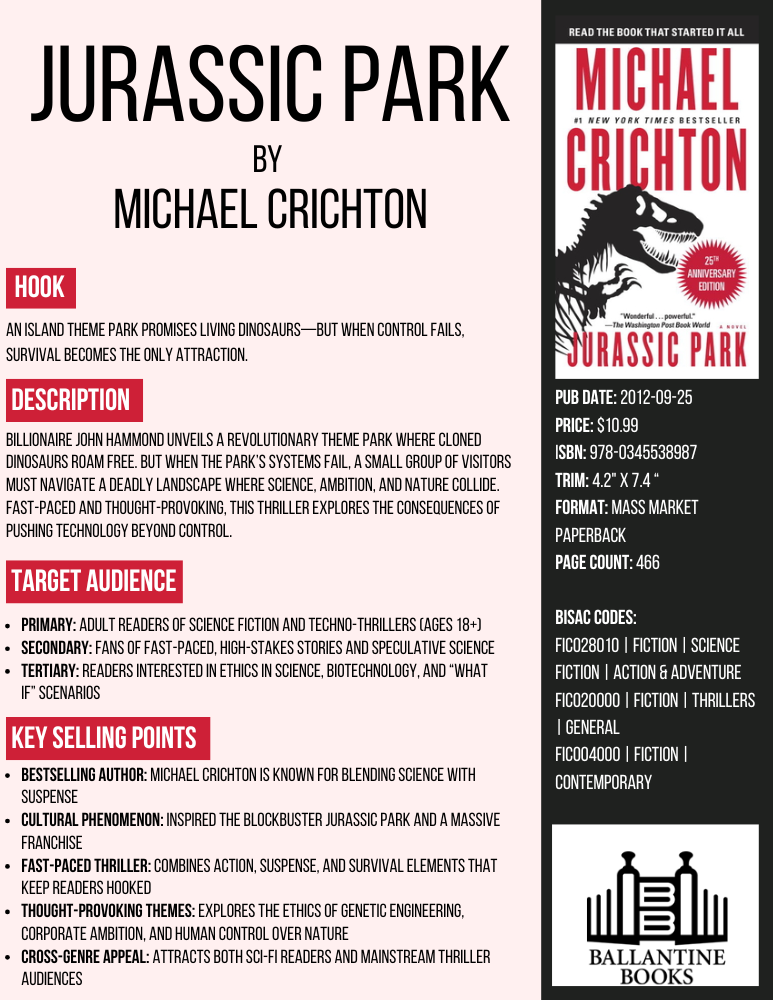
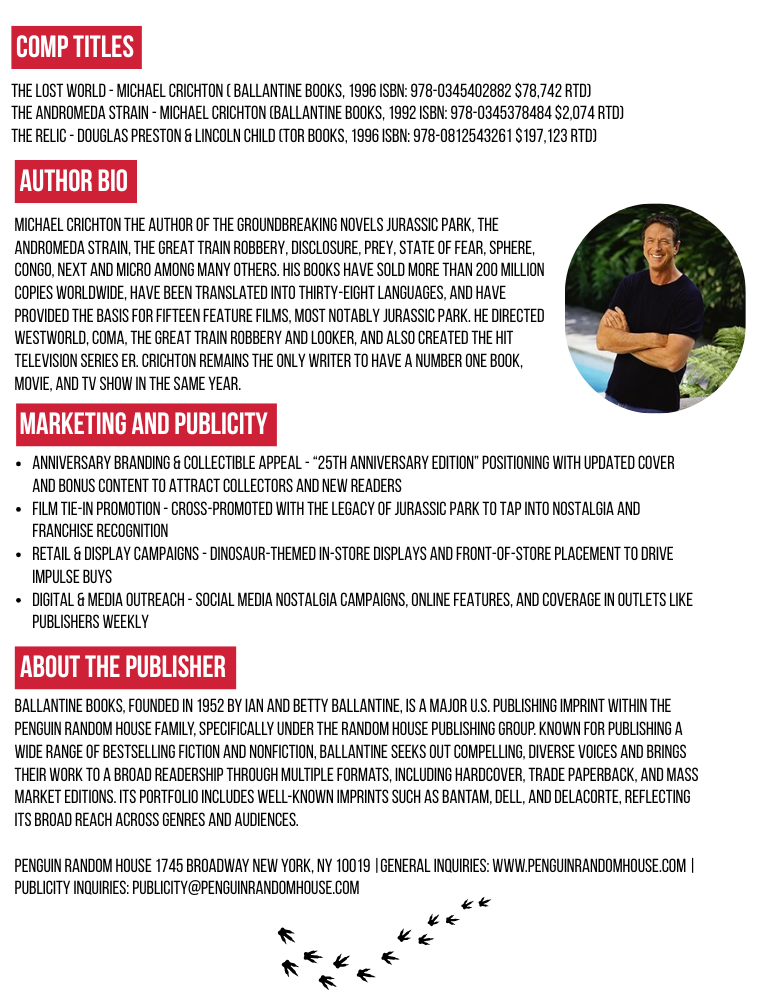
- Jurassic Park by Michael Crichton
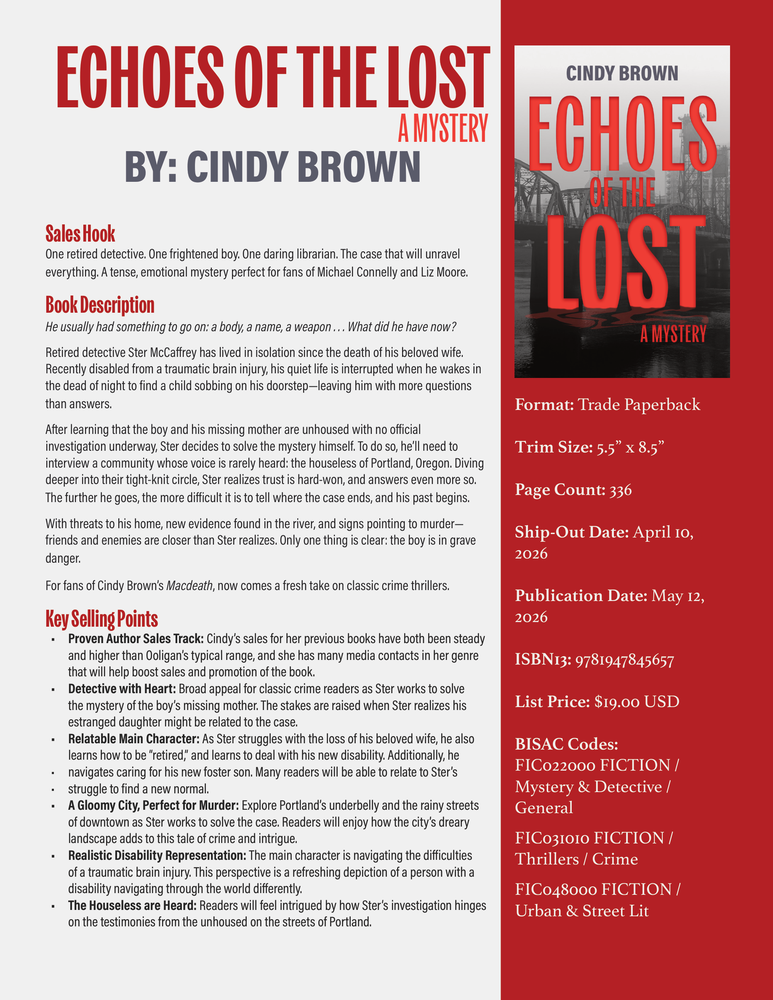
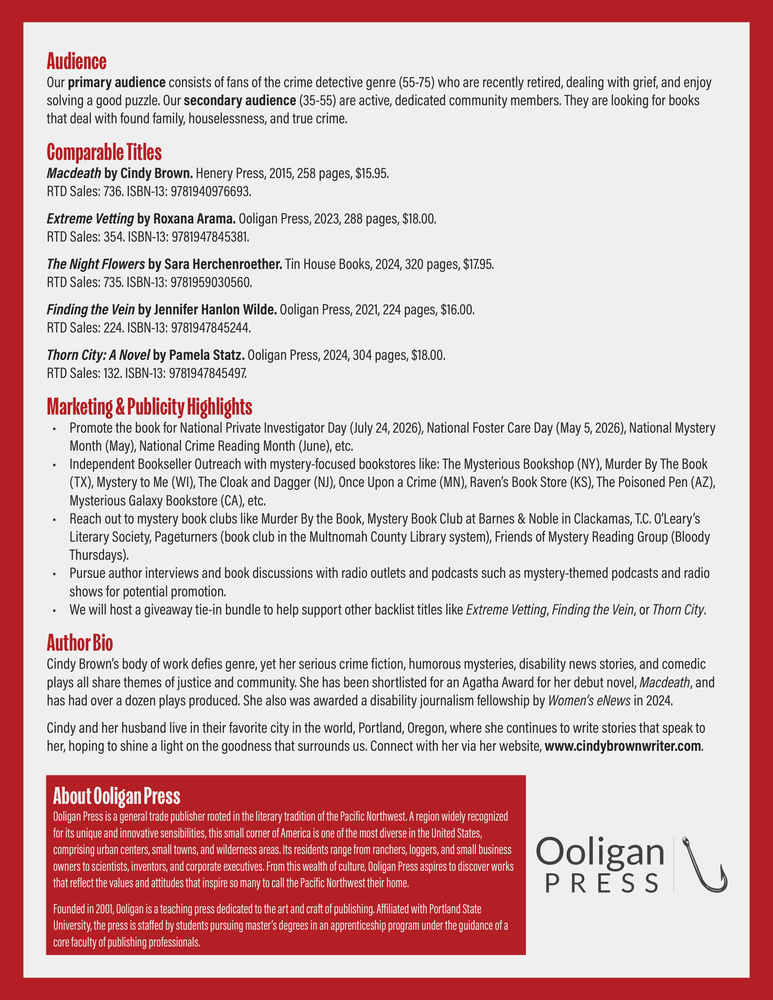
- Echoes of the Lost by Cindy Brown
Websites:
- Amazon.com
- If you have access to Bookscan.com please use that!!
- Edelweiss.plus (free to make an account!)
- BISG.org
- Under “BISAC”
- Canva.com
- If you have other design websites you prefer to use, please do so!
If You Give a Pig a Pancake
Beginning with a beloved classic for children over the last forty years, let’s think about what you’d expect a child’s book-resume to look like. It’ll have all the same qualifications as a teen or adult’s, but what would catch your eye as a parent of young children, a preschool or day care teacher, a children’s bookstore owner, or a librarian? For me, I like to start with the cover—especially when illustrating is involved!
First, we’ll head on over to the Amazon listing. From that page alone, because we’re using an already published book, we can glean a ton of information. If we right click on the cover, we can save or copy it to use for our Tip Sheet. In bold, we can easily identify the hook—that is, a couple of sentences to draw readers in. Because If You Give a Pig a Pancake is part of a major series, we also find Comp Titles, which are sometimes books by the same author and illustrator. There’s also author and illustrator profiles, and if we scroll down, we find a good amount of the details needed for our section on MetaData!
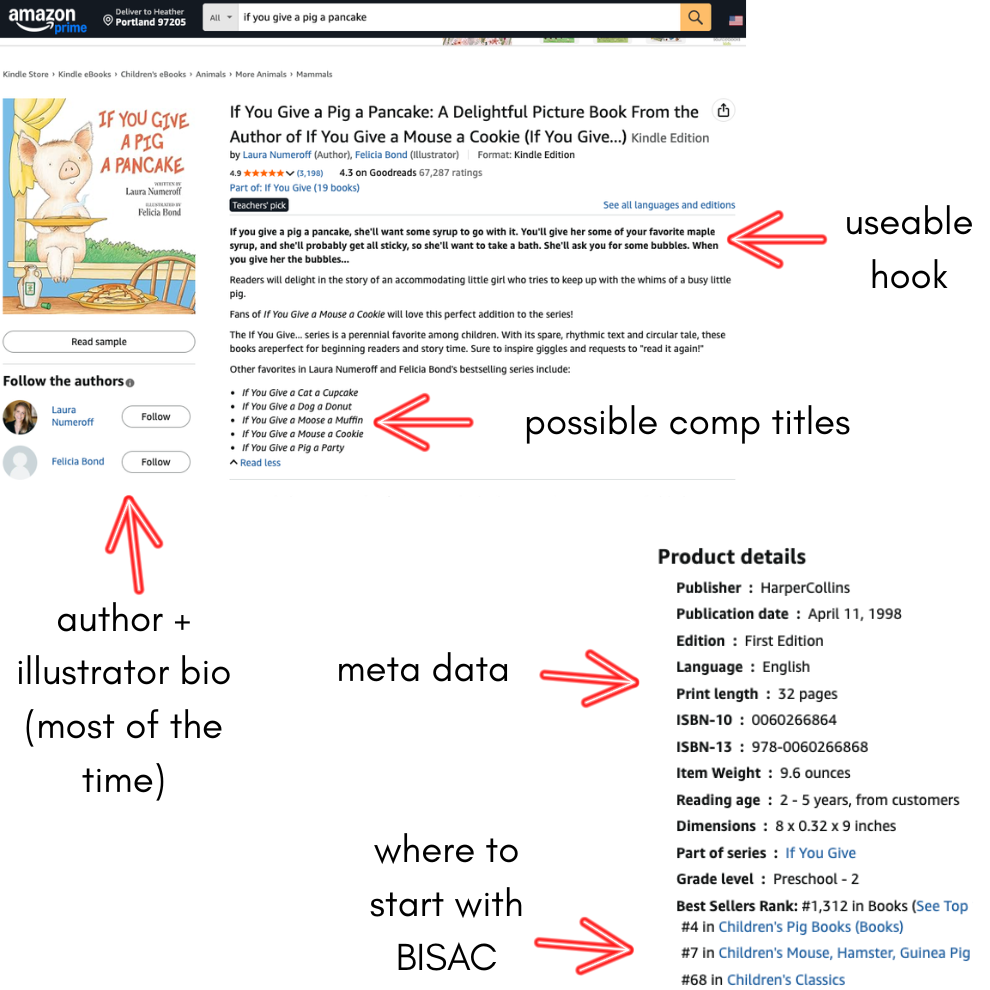
Missing on this page includes: Description, Target Audience beyond age and grade levels, Key Selling Points, the author bio and illustrator bio, the BISAC codes, Marketing and Publicity possibilities, and the publisher’s information beyond who it is.
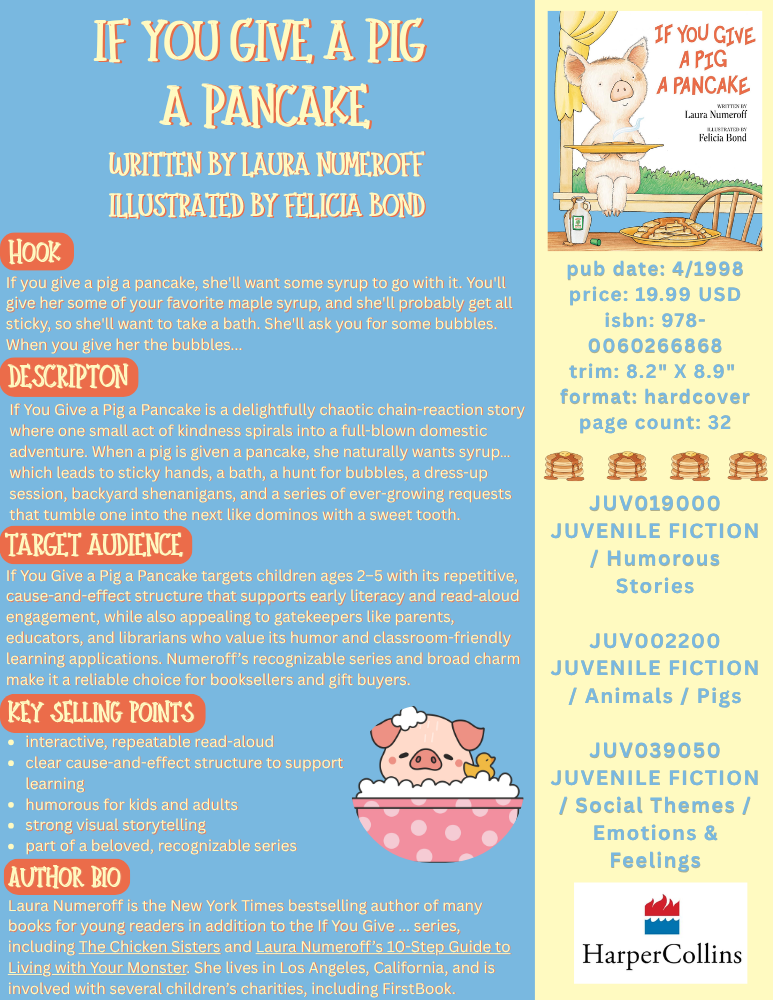
Starting with the Description of the contents, the best thing to do is read the book! Lucky for us, at a mere thirty-two pages including illustrations, it’s a quick read. There’s a pig who wants pancakes, a generous little girl who wants to give the pig breakfast, and a snowball effect. Who doesn’t love that? Once we’ve read the book and have written our Description, we can brainstorm about who, exactly, the Target Audience is. As I’ve said, this is a children’s book—but toddlers aren’t the ones buying it. Neither are they able to effectively decide what’s safe for them to read or know what’s best when it comes to their growth. That brings us back to the gatekeepers: parents, educators, and librarians. We’ll want to showcase what this title brings to children, as well as how it can be used for gatekeepers. With the age range of two to five years and the humorous cause-and-effect structure of the story, we can see the benefit this title brings to children who must learn there are consequences to their actions and gatekeepers who know, all too well, how difficult it is to get things back on track with little ones (and animals) around.
All this leads us into Key Selling Points! From our Hook, Description, and Target Audience, we can think of a few very good reasons this book (and the entire series) has had such massive staying power in the children’s sector of the publishing industry. The story is interactive, repeatable, supports learning, funny, has strong visual storytelling, and is part of an established, well-loved series. (See my model tip sheet at the end to view my Description, Target Audience, and Key Selling points in action!)
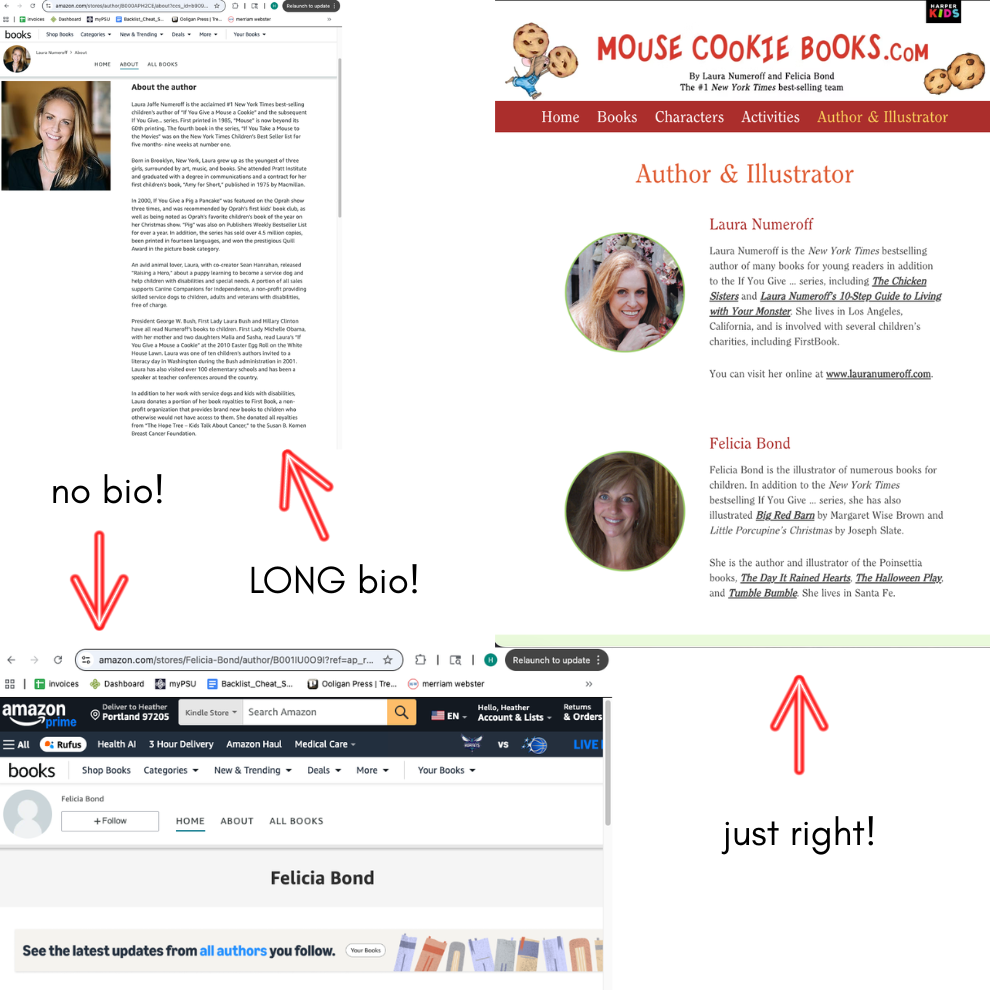
With those things out of the way, we can move on to the Author and Illustrator bios. As shown below, Amazon wasn’t the best option. Numeroff’s, while impressive, is too long! Bond, on the other hand, has an author page but no bio at all. A quick Google search brings us to Mousecookiebooks.com, where we find short and effective bio’s for both.
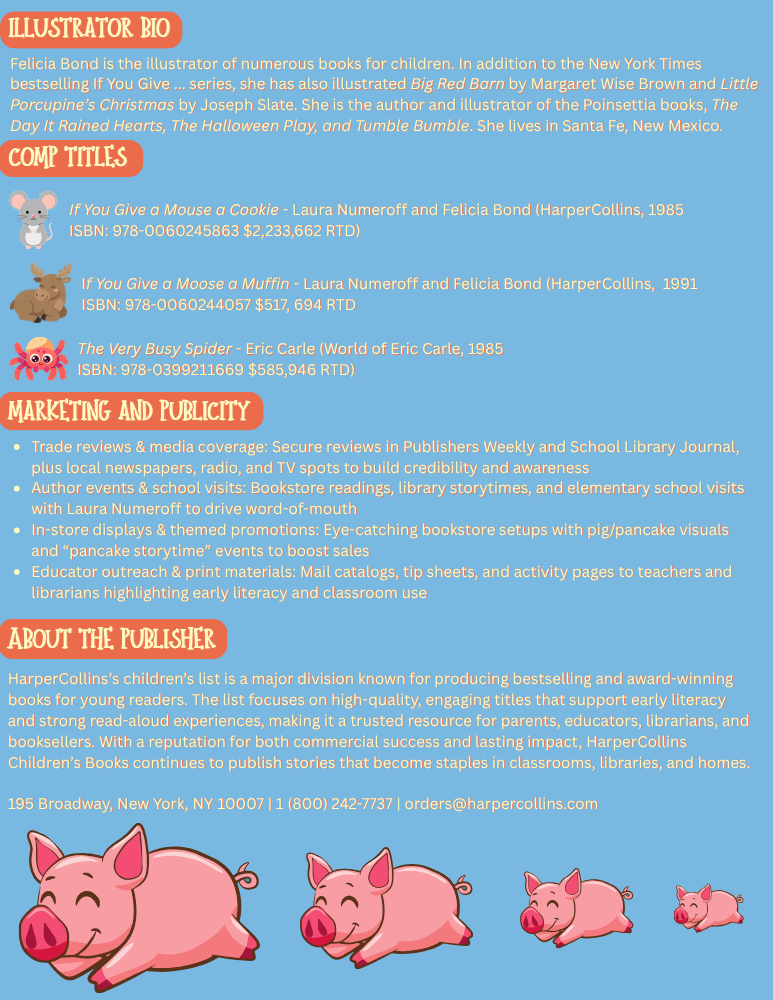
Returning to Comp Titles, it makes perfect sense that by the time If You Give a Pig a Pancake was published in 1998 we can use two titles in the series published previously—this is important because unless a publisher is re-publishing a new edition, there’s no Comp Title yet on the market to compare it to (unless you’re a time traveler). Similarly, we want titles published within the last three to five years as many readers are constantly looking for new books. With that said, If You Give a Mouse a Cookie (1985) and If You Give a Moose a Muffin (1991) are perfect choices; but what about a third? There’s nineteen other books in the series, but all of them are published after 1998. That means we’ll have to do some digging. Luckily, Amazon is wildly helpful here; as any reader who uses the website knows, it offers possibilities for further reading based on what similar titles have been purchased by other readers. After my research, I decided on Eric Carle’s The Very Busy Spider (1985) due to it having similar cause-and-effect storytelling and interactive reading.
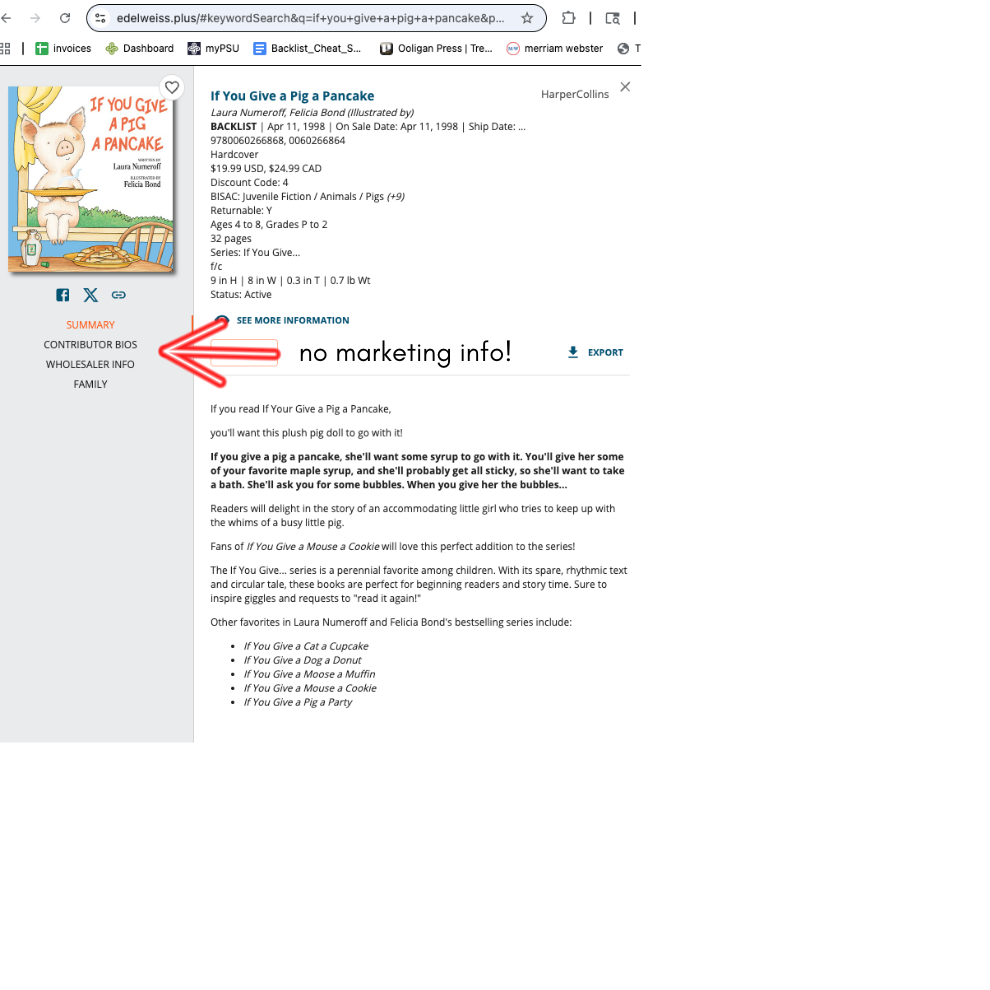
Now, when it comes to marketing and publicity, the possibilities are endless in the modern age with social media and the internet. However, this title was published in 1998 and Edelweiss.plus is more of a current and future website, rather than an archive for this kind of information. As seen below, there are options for summary, contributor bios, wholesaler info, and family (series). Because there are no pages for marketing and publicity for this title, we’ll have to use our minds! As a children’s book, and thinking all the way back to what the world was like in 1998, we can suggest options such as:
- Trade Reviews and Media Coverage
- Author Events and School Visits
- In-Store Displays and Themed Promo’s
- Educator Outreach and Print Materials
- And more… (who remembers the Scholastic Book Fairs??)
Onto the Publishing Info! Shown in the very first image on the bottom right, we know HarperCollins is the publisher. Their About Us page gives two paragraphs of what’s most important about the company. Condensing that information is necessary—as is remembering we are still focusing on a children’s book. After a quick Google search, we land on a wonderful page where they’re celebrating one hundred years of publishing just for kids. The text at the top is a perfect place to start brainstorming and drafting a few sentences about their children’s division. Their logo is available with a Google image search, where you can save it to use. And remember: always include available contact information on your Tip Sheet! Based on their website, we know HarperCollins headquarters are in New York, New York. Beyond that, they only have customer service information available.
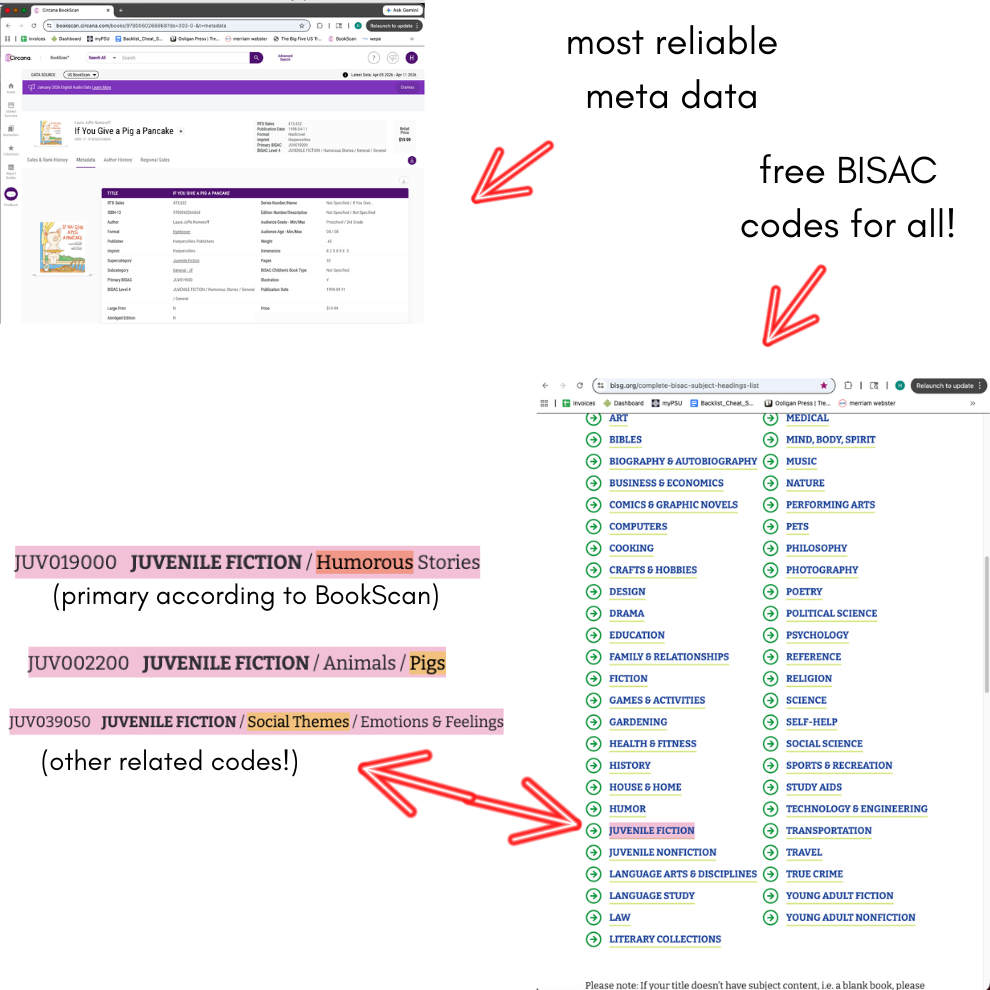
The final pieces of information we’re still looking for are the most reliable MetaData and BISAC codes. Amazon, as we saw earlier, did a pretty good job with the former, but if you have access to BookScan, it’s absolutely the best option to use them. Click here if you do, and it’ll take you straight to If You Give a Pig a Pancake’s MetaData page. If not, look below for what the page shows. When it comes to BISAC codes, there’s a huge amount for all kinds of books, and they’re updated regularly. For our title, we must use codes from the BISG website that refer only to Juvenile Fiction. From the MetaData on BookScan, we see the primary BISAC code. Beyond that, we have to do a little digging using keywords. I chose “Pig” and “Emotions & Feelings,” as both are listed as usable codes and are themes of the title.
Now that we have ALL of the needed information for the Tip Sheet (phew), the fun begins!
Design is an equally important aspect here. We want our Tip Sheet to be audience-forward, but it can’t be difficult to read or too busy. Because this is a children’s book, I went back to our Target Audience and thought about what would get the attention of retailers, schools, and librarians. With those things in mind, starting with an industry-standard letter size format, taking some time to study the cover design of our title, and using Canva, I chose complimentary colors, kid-friendly font, and graphics to add in some extra flair. But as you’ll see in our other two titles, our look for If You Give a Pig a Pancake is much less mature because the audience is so young. No matter how much a little kid loves dinosaurs, they won’t be reading Jurassic Park at five—though it didn’t stop me from adding in some dino footprints!
Without further ado…
Where to Send a Tip Sheet
The final stage is for the publisher to get their Tip Sheet out into the world so others will want to buy the book! Their destinations include:
- Booksellers (chains such as Barnes & Noble or indie shops like our local Annie Bloom’s Books)
- Libraries (both public and school)
- Wholesalers and distributors (Ingram is a big one)
- Media and reviewers (Publishers Weekly, etc.)
- Sales reps and internal teams
Hopefully you understand how to make a Tip Sheet now, why they’re an important aspect of the publishing industry, and maybe even want to make your own! Go on ahead and follow the directions from before for Jurassic Park (mine is below), Ooligan’s own Echoes of the Lost, designed by the Ooligan team, or any other book you’d like.
Please leave a comment and/or tag us on Instagram @ooliganpress—we’d love to see what you’ve made!
Happy Tip Sheet-ing!
Sources:
Portland State University Book Publishing Program, Marketing Court (WR 563, Tara Lehmann)
Edelweiss.plus
Book Industry Study Group (BISG.org)
Nielsen BookScan (via BookScan / Circana BookScan)