
Interactive fiction is a nebulous term. After all, isn’t all fiction interactive? You read or watch fictional books, shows, and films, which is interacting. If you search “interactive fiction,” Wikipedia will tell you that “Interactive fiction (IF) is software simulating environments in which players use text commands to control characters and influence the environment.” This definition sounds like any game, which is broadly true, but as you read further (or explore more), you will find that “interactive fiction” specifically refers to text-based games, usually with a strong narrative throughline. It is characterized by the second person perspective—addressing the reader/player as “you” directly—and having the reader affect the narrative to some degree.
In the publishing world, Choose Your Own Adventure books are an excellent example of interactive fiction without leaning so much into the game aspect. You, as the reader, get to decide which sections of the story to read by skipping through pages of the book, making the narrative change for your experience. Another less computer-based form of interactive fiction could be tabletop role-playing games like Dungeons & Dragons, which have modules with a base storyline but allow players to make different choices and experience situations in different ways. However, outside of book publishing, interactive fiction is almost always thought of in the same vein as computer or video games.
Some of the earliest computer games were simple interactive fiction text adventure or puzzle games, like Zork and The Hitchhiker’s Guide to the Galaxy (of which the game was released soon after the radio series began airing). These games allowed the player to type in commands for what “you” would do, although they were limited in scope both because of technology and to advance their narratives and goals. As technology has advanced, more and more computer games have shifted from text-based formats to visual formats, leaving interactive fiction games in the most traditional sense to a few niches.
Now, much of the available interactive fiction can be found on the appropriately named Interactive Fiction Database or IFDB.org. They host several competitions with several categories of interactive fiction and provide links or files to download and play all of the games on their site (as far as I have seen—but there are likely thousands of unique games which may be exceptions).
IF games fall into two main categories: text parsers, which allow the player to type in certain commands and explore the narrative, and hypertext games, which have the player click from link to link to advance the story. For non-programmers, hypertext IF games are usually more intuitive to create, as they function similar to a website or a formatted Google Doc and can be created without special technology. Text parser IF is usually more gamelike in its creation, but the most accessible way to create a text parser story is through Inform 7, which essentially allows the user to code in (mostly) plain English. On the other hand, hypertext IF also has a program dedicated to it: Twine.
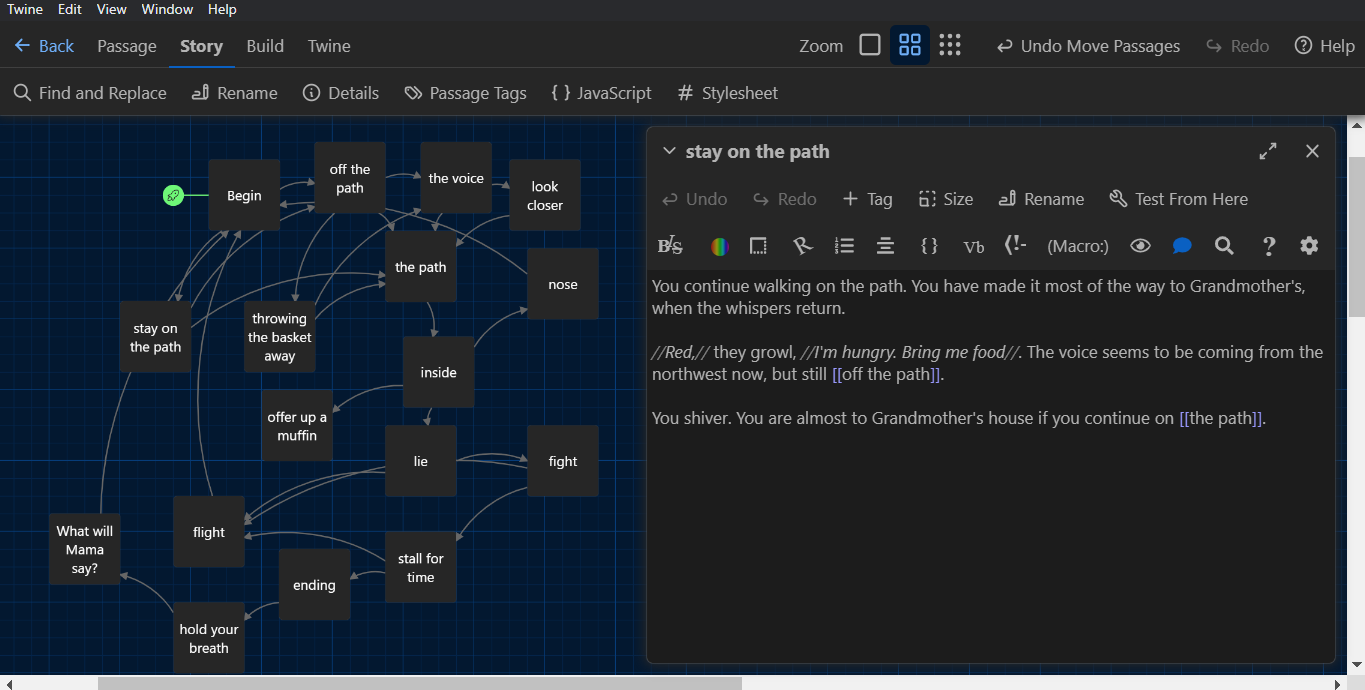
Twine is an open-source “tool for telling interactive, nonlinear stories,” and is designed so that no coding experience is required and the final result is completely HTML. It uses hypertext links to different parts or paths of a story to simulate choices within a narrative, with additional effects such as timers or different text appearances also being available to implement. Twinery.org has an online and downloadable version of the software that anyone can access and use for free.
Some very poignant stories are created using Twine, including Zoë Quinn’s Depression Quest and Anna Anthropy’s Queers in Love at the End of the World. If you play these IF games, you will notice a wide range of lengths and styles. Depression Quest formats choices like a quiz, but some of your “choices” are unavailable, while Queers in Love includes a very short timer that forces the player to choose very quickly and encourages many replays. Many other Twine stories have lighter or longer plotlines which can be found on Twinery.org, itch.io, IFDB.org, or their own dedicated website.
For a more comprehensive history and guide to Twine, check out Twining by Anastasia Salter and Stuart Moulthrop or Twinery.org. For tutorials on using Twine, check out A Total Beginner’s Guide to Twine 2.1 by Adam Hammond or YouTube videos like this one by DigitalExposureTV or this series by Vegetarian Zombie.